We are in the early stages of creating a small land-based community on 36 acres in County Offaly, Ireland. This is being progressed by a network of core members, supporters, volunteers and regular visitors.

Our Vision
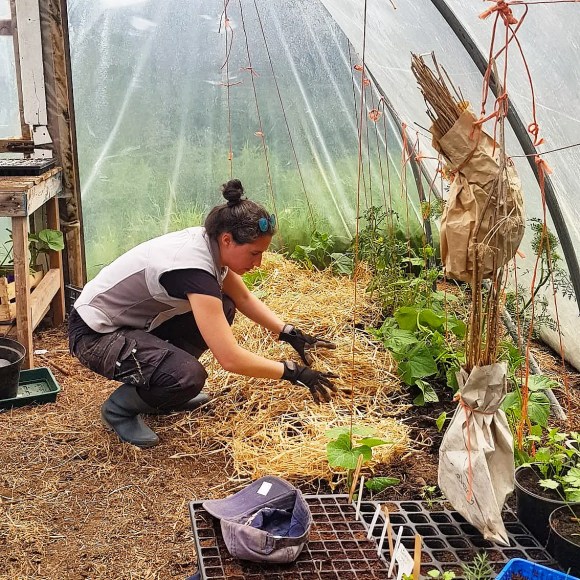
- Grow food while regenerating natural eco-systems instead of depleting them.
- Reverse rural depopulation and revitalize our local rural community and economy, create local green jobs and reduce commuting.
- Restore and enhance biodiversity.
- Live simply and minimise waste.
- Create a model of community living based on freedom, mutual support and respect.
- Deepen our connection with nature.
Our Goals for the Future
- Grow as much food as we can to meet the needs of members
- Build more sheds for tool storage and plant propagation
- Create ponds and improve current wetland
- Plant more food forests and improve existing ones.
- Expand agroforestry system
Projects
Vegetable Garden
Our vegetable garden is fully organic and managed using a no-dig system. It supplies a significant portion of our vegetable needs and helps us to feed our visitors. Instead of digging and cultivating the ground, we smother weeds with cardboard/newspaper and well-rotted cow manure.


The no-dig garden is in its 6th year now and producing very tasty, nutritious, biologically active vegetables. It never needs watering.
In part of the garden, we use polyculture – combining vegetables with beneficial plants and with other ‘companion’ vegetables to increase plant health. We are saving seeds and allowing vegetables to self-seed freely.
We have some trees and shrubs mixed into the vegetable garden – it is a form of open canopy forest garden.
Food Forests

Food forests are food producing systems that mimic forest eco-systems in order to
- produce more food per square metre
- …with less maintenance.
- sequester more carbon
- house more biodiversity …than conventional agricultural systems.
We have a small, fully established 400m2 food forest and 3 more food forests in which we are working away at planting all of the layers. Some of the plants included are:
- Walnut, Cob, Apple, cherry autumn olive and juneberry (Canopy layer)
- Blackcurrants, chokeberries, raspberries, goji berries, blackberries, oregan grape and pheasant berries (Shrub layer).

- Rose and kiwi (Climber layer)
- Mallow, lovage, Ishikura onion, daffodil garlic, sorrel and perennial kale (Herbaceous layer).
- Strawberry, wild rocket, sage, thyme, mint, rhubarb and ground ivy (Groundcover layer).
- Jerusalem artichoke, tiger nut and Maximillian sunflower (Root layer)
We have started planting a food forest in Ferbane Business Park in conjunction with Ferbane Tidy Towns, St Hilda’s Services. This is Ireland’s first public food forest
Cattle
We have a small herd of about 10 angus beef suckler cattle who graze on 12 acres of diverse meadow. We aim to manage them using a mob grazing system.
Mob grazing aims to mimic grazing animals’ behaviour in the wild. The cattle are rotated to a fresh, small paddock each day. The grass and other plants in each paddock have a chance to grow long and put on a lot of root mass before the cattle graze and trample them.

The high density of cattle manuring the ground, the trampling effect of their hooves and the plants shedding roots stimulates and increases microbial activity and adds organic matter in the soil. Mob grazing sequesters carbon, increases soil fertility, increases biodiversity and produces healthier cattle.

This is happening more slowly than anticipated on our farm as the soil is very depleted and light. We are beginning to gradually convert the meadows into silvopasture, which involves trees being incorporated into the mob grazing system. Research has shown silvopasture to enhance all of the benefits of mob grazing further.
Hens
We have hens which supply us with eggs. They also help us to reduce waste by eating kitchen scraps and help us to cultivate ground for growing vegetables and keep grass down around young trees. We sometimes use a chicken tractor to move them around. Their diet is organic, locally grown, corn free, soy free and GM free.
We hope to expand egg production into a commercial operation.

Native Woodland
We planted 6.5 acres of native woodland in 2015. It is made up of oak, Scott’s pine, hawthorn, birch, rowan and alder. We are starting to see early signs of native woodland ground cover plants creeping in.

Education

We offer workshops in a wide range of topics, including permaculture, foraging, agroforestry, mushroom cultivation, natural textiles, fruit tree pruning and food preservation.
We are open to new workshop ideas and new facilitators, so contact us if you have something you’d like to offer.

Coppice Woodland
In 2019, we planted ¼ acre of coppice woodland, comprising of hazel, alder, oak, willow and rowan. This will provide some of our firewood needs. We will continue to plant more to become fully self-sufficient in firewood.

Hedgerow Management

We are very fortunate to have 100 year+ old hedgerows, some of which can be classed as heritage hedgerows. We do not trim the tops, only the sides to prevent them from obstructing roads. Our hedgerows are rich in plant and animal biodiversity. They provide much needed shelter from the wind, food and medicine and they increase soil fertility on the farm.
We are currently working on closing up gaps in the hedgerows by planting native trees and shrubs and traditional hedge laying.
Syntropic Agroforestry Strips
We have five 35-metre-long agroforestry strips containing apple, pear, cherry, hazel, walnut, sweet chestnut and gingko biloba trees, underplanted with a mix of other edibles and beneficial plants.


Agoroforestry strips are similar to a food forest but have more order, making them easier to manage on a commercial scale.
Syntropic agroforestry makes use of the natural connections between communities of plants to maximise yield, water conservation, soil building, biological activity and carbon sequestration.
Bees

We have a hive of honey bees. We are still learning how to best care for them. We have planted a year round supply of nectar for them (e.g, gorse, elaeagnus, comfrey, viburnum) on top of the many wild nectar-rich plants already here (e.g. clover, beaked hawksbeard, ivy).
Salvaging & Upcycling
With help from our wider community/network of helpers and visitors, we are continuously salvaging pallets, building materials and anything else useful we come across. We use pallets as firewood as well as upcycling them into gates, furniture and other things. This summer, we plan to build a shed, a chicken coupe and an outdoor kitchen from mostly salvaged materials. We also salvage cardboard and newspaper for our no-dig gardens.

Humanure

Humans are the only animals who flush their excrement into the sea and other water bodies instead of returning excess nutrients to the earth. We have only been using flush toilets for about 100 years. In the course of that time, our soils have rapidly depleted whilst the ocean has become dangerously nitrified.
At Coole Eco community, we use compost toilets, also known as dry toilets. Sawdust is thrown into the toilet after each use, neutralizing the nitrogen and smell. When composted correctly for 2 years, the end product is guaranteed to be free of all pathogens and cannot be distinguished from any other rich compost.
Field Scale Crops
We are growing field-scale potatoes, pumpkins and squash.

Sign up to our email list for updates
 Coole Eco Community